Research

Publications
Jungblut, M. & Aldridge, D. (2004): Musik als Brücke zur Sprache –
die musiktherapeutische Behandlungsmethode “SIPARI®“
bei Langzeitaphasikern. Neurologie & Rehabilitation, 10 (2):
69-78.
Jungblut, M. (2005): Music therapy for people with chronic
aphasia: a controlled study. In: Aldridge, D. (Ed.): Music
therapy and neurological rehabilitation. Performing health.
Jessica Kingsley Publishers, London and Philadelphia, 189-
211.
Jungblut, M. Gerhard, H. & Aldridge, D. (2006): Die Wirkung einer
spezifischen musiktherapeutischen Behandlung auf die
sprachlichen Leistungen eines chronisch kranken
Globalaphasikers – eine Falldarstellung. Neurologie &
Rehabilitation 12 (6), 339-347.
Jungblut, M., Suchanek, M., Gerhard, H. (2009): Long-term
recovery from chronic Global aphasia: a case report. Music
& Medicine, Vol. 1, No. 1, 61-69.
Jungblut, M. (2009): SIPARI®: a music therapy intervention for
patients suffering with chronic, nonfluent aphasia. Music &
Medicine, Vol. 1, No. 2., 102-105 .
Jungblut, M., Huber, W., Pustelniak, M., Schnitker, R., M. (2009):
The neural substrates of chanted vowel changes in rhythm
sequences. NeuroImage, 47 (1): S119.
Jungblut, M. (2010): SIPARI® Musikunterstützte
Sprachanbahnung bei chronischer Aphasie. Aphasie und
verwandte Gebiete, 1, 69-79.
Jungblut, M., Huber, W., Pustelniak, M., Schnitker, R. (2011):
Neuronale Korrelate rhythmischer Strukturen beim Singen
- eine fMRT-Studie. Neurologie & Rehabilitation, 17 (1): 33-
39.
Jungblut, M., Huber, W., Pustelniak, M. and Schnitker, R. (2012):
The impact of rhythm complexity on brain activation
during simple singing - an event-related fMRI study.
Restorative Neurology and Neuroscience, 30 (1): 39-53.
Jungblut, M., Huber, W., Mais, C. and Schnitker, R. (2014): Paving
the way for speech: Voice-training-induced plasticity in
chronic aphasia and apraxia of speech - three single cases.
Neural Plasicity, Article ID 841982, 14 pages,
http://dx.doi.org/10.1155/2014/841982.
Jungblut,M (2014): SIPARI® bei chronischer Aphasie und
Sprechapraxie – Was fMRT-Untersuchungen zeigen.
Aphasie und verwandte Gebiete,3, 29-36.
Jungblut, M., Huber, W., Schnitker, R. (2016): Rhythm structure
influences auditory-motor interaction during anticipatory
listening to simple singing. Journal of Speech Pathology &
Therapy, 1: 108.doi:10.4172/jspt.1000108.
Jungblut, M., Mais, C. Huber, W., Binkofski, F.C., Schüppen, A.
(2020): 5-year course of therapy-induced recovery in
chronic non-fluent aphasia - Three single cases – CORTEX,
Vol. 132, pp. 147-165.
https://doi.org/10.1016/j.cortex.2020.08.009
Jungblut, M., Mais, C., Binkofski F.C., Schüppen, A. (2022): The
efficacy of a directed rhythmic-melodic voice training in the
treatment of chronic non-fluent aphasia—Behavioral and
imaging results. Journal of Neurology.
http://dx.doi.org/10.1007/s00415-022-11163-2
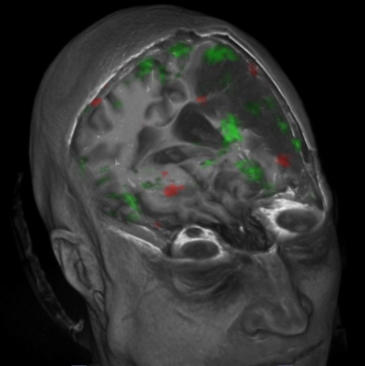
Red - before therapy
Green - after therapy
Thanks
to
André
Schüppen
(Brain
Imaging
Facility,
IZKF,
University Hospital Aachen)!
The
results
of
a
randomized
controlled
trial
(RCT)
were
recently
published in
Journal of Neurology
.
For further information, please contact
Dr. rer. medic. Monika Jungblut
Am Lipkamp 14
Duisburg
Germany
tel.: +49 203 711319

S I P A R I ®
evidence-based music-supported therapy
for patients suffering from chronic aphasia

ePoster:
HBM 2016, Genf WCNR 2016, Philadelphia, PA OHBM 2014 Poster 3734, Hamburg, Germany OHBM 2014 Poster 1530, Hamburg, Germany HBM 2013, Seattle, WA OHBM 2010, Barcelona, Spain OHBM 2009, San Francisco, CA Poster GAB 2009 Poster GAB 2006Our
current
research
with
functional
imaging
(fMRI)
regarding
the
effects
of
rhythmic-melodic
voice
training
SIPARI®
on
language
and
speech
motor
capabilities,
and
associated
reorganization
in
patients
with
chronic
aphasia
and
apraxia
of
speech
is
carried
out
in
cooperation
with
the
University
Hospital
Aachen
(Prof.
Binkofski,
Prof.
Huber)
and
the
Brain
Imaging
Facility
of
the
Interdisciplinary
Centre
for
Clinical
Research at the University Hospital Aachen.
Our
recent
study
with
patients
suffering
from
chronic
aphasia
and
apraxia
of
speech
already
demonstrated
that
after
50
SIPARI®
sessions
activation
changed
to
left-hemisphere
regions
round
the
lesion
(extended
black
area)
correlating
with
significant
improvements
of
language
capabilities
(assessed
by
the
Aachener
Aphasie
Test).
Please
see
for
example
the
results
of
one
participant
of
the
study
in
a
3D-model.
For
further
information, please see
Neural Plasticity
.
The
results
of
a
further
long-term
study,
which
documented
the
rehabilitation
process
of
three
patients
over
a
period
of
5
years,
were recently published in
Cortex
.

2026 © Dr. Jungblut
Disclaimer
The
SIPARI®
therapy
was
developed
by
Dr.
Jungblut
and
is
applied
exclusively
by
trained
and
certified
therapists
or
Dr.
Jungblut
herself.
Those,
who
are
interested
in
this
treatment
should
check
that
the
providing therapist successfully completed the SIPARI® trainings.



Research
S I P A R I ®
evidence-based music-supported therapy
for patients suffering from chronic aphasia



ePoster:
HBM 2016, Genf WCNR 2016, Philadelphia, PA OHBM 2014 Poster 3734, Hamburg, Germany OHBM 2014 Poster 1530, Hamburg, Germany HBM 2013, Seattle, WA OHBM 2010, Barcelona, Spain OHBM 2009, San Francisco, CA Poster GAB 2009 Poster GAB 2006Our
current
research
with
functional
imaging
(fMRI)
regarding
the
effects
of
rhythmic-melodic
voice
training
SIPARI®
on
language
and
speech
motor
capabilities,
and
associated
reorganization
in
patients
with
chronic
aphasia
and
apraxia
of
speech
is
carried
out
in
cooperation
with
the
University
Hospital
Aachen
(Prof.
Binkofski,
Prof.
Huber)
and
the
Brain
Imaging
Facility
of
the
Interdisciplinary
Centre
for
Clinical
Research at the University Hospital Aachen.
Our
recent
study
with
patients
suffering
from
chronic
aphasia
and
apraxia
of
speech
already
demonstrated
that
after
50
SIPARI®
sessions
activation
changed
to
left-hemisphere
regions
round
the
lesion
(extended
black
area)
correlating
with
significant
improvements
of
language
capabilities
(assessed
by
the
Aachener
Aphasie
Test).
Please
see
for
example
the
results
of
one
participant
of
the
study
in
a
3D-model.
For
further
information, please see
Neural Plasticity
.
The
results
of
a
further
long-term
study,
which
documented
the
rehabilitation
process
of
three
patients
over
a
period
of
5
years,
were recently published in
Cortex
.
Red - before therapy
Green - after therapy
Thanks
to
André
Schüppen
(Brain
Imaging
Facility,
IZKF,
University Hospital Aachen)!
The
results
of
a
randomized
controlled
trial
(RCT)
were
recently
published in
Journal of Neurology
.
For further information, please contact
Dr. rer. medic. Monika Jungblut
Am Lipkamp 14
Duisburg
Germany
tel.: +49 203 711319
Publications
Jungblut, M. & Aldridge, D. (2004): Musik als Brücke zur Sprache –
die musiktherapeutische Behandlungsmethode “SIPARI®“
bei Langzeitaphasikern. Neurologie & Rehabilitation, 10 (2):
69-78.
Jungblut, M. (2005): Music therapy for people with chronic
aphasia: a controlled study. In: Aldridge, D. (Ed.): Music
therapy and neurological rehabilitation. Performing health.
Jessica Kingsley Publishers, London and Philadelphia, 189-
211.
Jungblut, M. Gerhard, H. & Aldridge, D. (2006): Die Wirkung einer
spezifischen musiktherapeutischen Behandlung auf die
sprachlichen Leistungen eines chronisch kranken
Globalaphasikers – eine Falldarstellung. Neurologie &
Rehabilitation 12 (6), 339-347.
Jungblut, M., Suchanek, M., Gerhard, H. (2009): Long-term
recovery from chronic Global aphasia: a case report. Music
& Medicine, Vol. 1, No. 1, 61-69.
Jungblut, M. (2009): SIPARI®: a music therapy intervention for
patients suffering with chronic, nonfluent aphasia. Music &
Medicine, Vol. 1, No. 2., 102-105 .
Jungblut, M., Huber, W., Pustelniak, M., Schnitker, R., M. (2009):
The neural substrates of chanted vowel changes in rhythm
sequences. NeuroImage, 47 (1): S119.
Jungblut, M. (2010): SIPARI® Musikunterstützte
Sprachanbahnung bei chronischer Aphasie. Aphasie und
verwandte Gebiete, 1, 69-79.
Jungblut, M., Huber, W., Pustelniak, M., Schnitker, R. (2011):
Neuronale Korrelate rhythmischer Strukturen beim Singen
- eine fMRT-Studie. Neurologie & Rehabilitation, 17 (1): 33-
39.
Jungblut, M., Huber, W., Pustelniak, M. and Schnitker, R. (2012):
The impact of rhythm complexity on brain activation
during simple singing - an event-related fMRI study.
Restorative Neurology and Neuroscience, 30 (1): 39-53.
Jungblut, M., Huber, W., Mais, C. and Schnitker, R. (2014): Paving
the way for speech: Voice-training-induced plasticity in
chronic aphasia and apraxia of speech - three single cases.
Neural Plasicity, Article ID 841982, 14 pages,
http://dx.doi.org/10.1155/2014/841982.
Jungblut,M (2014): SIPARI® bei chronischer Aphasie und
Sprechapraxie – Was fMRT-Untersuchungen zeigen.
Aphasie und verwandte Gebiete,3, 29-36.
Jungblut, M., Huber, W., Schnitker, R. (2016): Rhythm structure
influences auditory-motor interaction during anticipatory
listening to simple singing. Journal of Speech Pathology &
Therapy, 1: 108.doi:10.4172/jspt.1000108.
Jungblut, M., Mais, C. Huber, W., Binkofski, F.C., Schüppen, A.
(2020): 5-year course of therapy-induced recovery in
chronic non-fluent aphasia - Three single cases – CORTEX,
Vol. 132, pp. 147-165.
https://doi.org/10.1016/j.cortex.2020.08.009
Jungblut, M., Mais, C., Binkofski F.C., Schüppen, A. (2022): The
efficacy of a directed rhythmic-melodic voice training in the
treatment of chronic non-fluent aphasia—Behavioral and
imaging results. Journal of Neurology.
http://dx.doi.org/10.1007/s00415-022-11163-2

2026 © Dr. Jungblut
Disclaimer

The
SIPARI®
therapy
was
developed
by
Dr.
Jungblut
and
is
applied
exclusively
by
trained
and
certified
therapists
or
Dr.
Jungblut
herself.
Those,
who
are
interested
in
this
treatment
should
check
that
the
providing
therapist
successfully completed the SIPARI® trainings
.